For many years, the fintech story was told as a private-sector story. Startups would move faster than banks, use technology better, reduce costs, improve customer experience and force the financial industry to modernise.
That story is still partly true. But it is no longer complete.
A quieter and more important shift is taking place: governments are starting to act like fintech companies. They are building payment apps, digital wallets, real-time payment systems, identity layers and data-sharing infrastructure. In some markets, the most important financial innovation is not coming from a startup or a bank. It is coming from the state.
The scale is easy to underestimate. In July 2026, India’s UPI processed 23.66 billion transactions in a single month, worth roughly 29.9 lakh crore rupees. Brazil’s Pix now reaches about 148 million people, close to 80 per cent of the adult population, and handled 79.8 billion transactions in 2025. Neither system was built by a startup. One was built by a bank-owned utility under central bank oversight; the other by the Central Bank of Brazil itself.
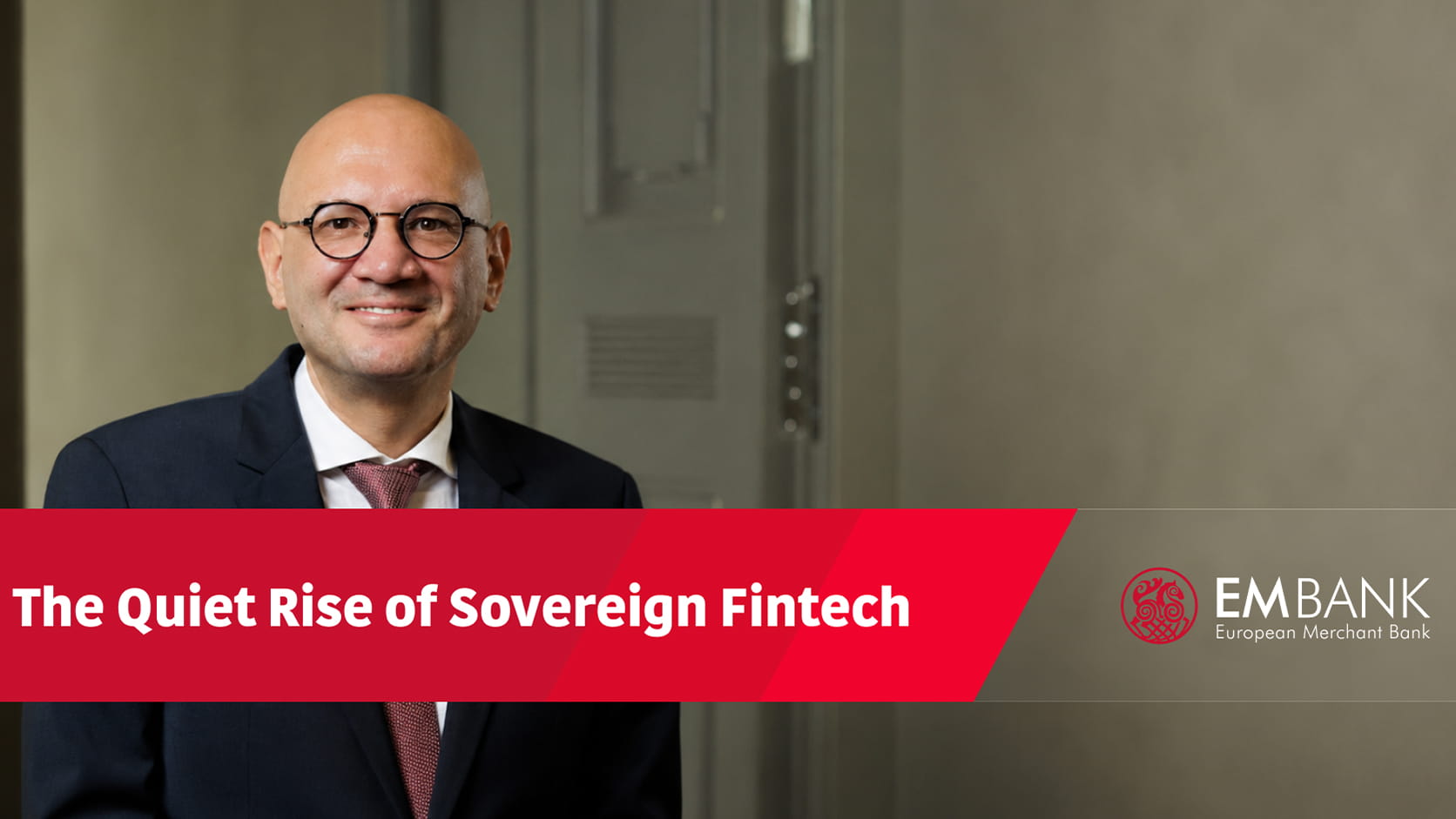
This is what I call the rise of sovereign fintech: state-backed digital infrastructure that enables payments, identity, financial access and data exchange at a national scale.
The biggest fintech competitor of the next decade may not be another startup with a better app. It may be the public infrastructure layer itself. For banks and fintechs, this changes the question completely. The challenge is no longer only how to compete with each other, but how to build value on top of systems the state is now creating.
From Regulator to Builder
Traditionally, governments played three roles in finance: they regulated the market, supervised institutions and protected the stability of the system. Banks built the products. Payment companies built the networks. Fintechs built the user experience.
That division is now changing.
Governments have realised that digital financial infrastructure is too strategic to leave entirely to private platforms. Payments, identity, data access and wallets are no longer just technical tools. They are national capabilities.
This is why public institutions are moving from regulation to construction. Central banks are launching real-time payment systems. Governments are building digital identity frameworks. Public agencies are creating consent-based data-sharing layers. In some cases, national wallets are becoming gateways to both public and private services.
The state does not want to replace every bank or fintech. What it wants is to own the rails on which digital finance operates. For the private sector, that is a major shift: the government is no longer only the referee. In some markets, it is also becoming the platform.
Why Governments Are Acting Like Startups
Governments are not building fintech infrastructure because it is fashionable. They are doing it because the economics and politics of financial services have changed.
Digital payments, identity and data exchange are now too important to remain fragmented, expensive or fully dependent on private platforms. A country that cannot move money instantly, verify identity digitally or share financial data securely is at a disadvantage.
The motivations are clear. Governments want lower payment costs, faster public transfers, greater financial inclusion, less dependence on cash, better tax visibility and stronger control over national financial infrastructure. They also want to increase competition in banking by making basic infrastructure available to more players.
The return on that investment can be extraordinary. Research published by the Bank for International Settlements notes that Pix cost roughly four million dollars to develop and generated an estimated 5.7 billion dollars in cost savings in 2021 alone. No private payment company would accept those economics, because no private payment company can capture that value. A state can, because the savings show up in the wider economy rather than on a balance sheet.
This is the structural advantage governments hold over startups. A startup must monetise transactions, users or data. A government can build infrastructure as a public utility. It does not need to make money from every payment. It can focus on scale, access and policy outcomes. Startups optimise for growth; governments optimise for scale, control and national capability.
Models of Sovereign Fintech
Sovereign fintech does not look the same in every market. India, Brazil and Europe show three different models.
India represents the platform model. UPI, Aadhaar and India Stack created a public digital infrastructure that private companies could build on top of. The government did not need to build every customer-facing product itself. Instead, it created the identity, payment and data layers that enabled banks, fintechs and technology companies to innovate at scale.
The Reserve Bank of India’s own data shows both the power and the limits of this model. In the second half of 2025, UPI accounted for 85.5 per cent of digital payment volume but only 9.5 per cent of digital payment value. UPI has captured everyday spending almost completely, while large-value flows still move through older rails such as RTGS. Public infrastructure won the retail layer first. That is not a small victory, but it is a specific one.
Brazil represents the payment disruption model. Pix, launched by the Central Bank of Brazil in 2020, overtook combined credit and debit card transactions by 2023 and now accounts for close to 40 per cent of e-commerce transactions. The price difference explains much of the adoption: the average Pix merchant fee was around 0.33 per cent in 2025, against a card merchant discount rate averaging roughly 2.3 per cent in Brazil. When a public rail is seven times cheaper, merchant behaviour does not need to be persuaded. It simply moves.
Europe exemplifies the trust-and-identity model, and it is the slowest of the three. The revised eIDAS regulation entered into force in May 2024 and requires member states to make an EU Digital Identity Wallet available to citizens by late 2026. Progress has been uneven. In early 2026, ENISA reported that no wallet had yet been deployed or certified and that the technical specification remained a work in progress; France, Germany and Austria are among the more prepared, while the Commission itself has signalled doubt that every member state will meet the deadline.
That delay is worth watching rather than dismissing. Identity is the gateway to finance, public services, compliance, data portability and digital trust. Whoever controls the identity layer controls one of the most important entry points into the digital economy. Europe is moving slowly, but it is building the layer that is hardest to replace once it exists.
Why This Changes the Competitive Landscape for Fintechs
For fintechs, sovereign fintech is both a threat and an opportunity.
The threat is clear. Many fintech business models were built to address inefficiencies in payments, onboarding, identity verification, data access and user experience. When the state builds instant payment rails, digital identity systems and open data infrastructure, some of those advantages become public utilities.
This compresses margins in a very literal way. If account-to-account payments become instant and nearly free, it becomes harder to charge high fees for basic transactions. If digital identity is standardised, onboarding stops being a differentiator. If data-sharing is regulated and interoperable, access to financial data is no longer controlled only by large banks or private platforms.
India offers the clearest illustration of what happens next. PhonePe processes close to half of all UPI transactions and serves more than 650 million registered users, yet its revenue from payments themselves is effectively zero. Its profitability comes from what sits on top: insurance, lending and other financial services attached to the payment relationship. Scale on the rails is not the business. It is the distribution channel for the business.
That is the strategic lesson. When public infrastructure improves, the value does not disappear; it moves up the stack, towards credit, wealth management, merchant tools, SME finance, embedded finance, insurance, compliance automation and cross-border solutions. The best fintechs will not fight public infrastructure. They will use it. In a sovereign fintech world, the winners will be those who understand where the state ends and where private innovation begins.
The Counter-Argument Worth Taking Seriously
It would be easy to conclude that public rails inevitably crowd out private players. The evidence does not fully support that.
The BIS study of Pix found the opposite of displacement in several places. Adoption increased the use of competing instruments rather than replacing them: payment slips rose 5.7 per cent, bank wires 4.5 per cent and debit card acceptance among merchants 1.2 per cent. Transaction growth was shared roughly equally between digital and traditional banks for individuals, and incumbents actually gained more among firms. A one per cent increase in Pix users was associated with a 0.8 per cent increase in first-time bank account openings. Public rails expanded the market before they redistributed it.
There is a harder counter-argument on the other side, and it concerns money. UPI is free at the point of use because India abolished the merchant discount rate on it, which means the cost of running the system sits somewhere else. The government has been compensating processors directly, with roughly 1,500 crore rupees allocated for the 2024-25 financial year and around 2,000 crore rupees budgeted for 2026-27. Banks have lobbied quietly for years to reintroduce a fee. Volume growth is also moderating, at 22 per cent year-on-year in July 2026 against 35 per cent a year earlier.
None of this makes UPI a failure. It makes it a subsidy, and subsidies are political decisions that can be reversed. Any fintech strategy that assumes free public rails forever is assuming a policy position, not an infrastructure fact.
The Risks: Exclusion, Surveillance and State Overreach
Sovereign fintech can create enormous public value, but it is not automatically positive.
When governments build payment rails, wallets and identity systems, they also gain new forms of visibility and influence. A national digital wallet can improve inclusion, but it can also become a tool for surveillance. A real-time payment rail can reduce costs, but it can also concentrate operational risk in a single national system.
Exclusion is the risk that is easiest to overlook, because it is invisible in aggregate statistics. India performs around 312 million Aadhaar biometric authentications a month, of which roughly 20.3 million fail. A 6.5 per cent failure rate looks tolerable on a dashboard. It means millions of people each month standing in front of a machine that does not recognise them, and those people are disproportionately the ones for whom the system was justified in the first place. Inclusion designed at national scale produces exclusion at national scale too.
The issue is not whether the state should build. In many cases, it should. The issue is how it builds. Public digital infrastructure must be open, interoperable and accountable. It must protect privacy, allow competition, provide meaningful fallback for people the system fails, and avoid becoming a monopoly controlled by bureaucracy. Otherwise, sovereign fintech may replace private inefficiency with public overreach.
The state can be a builder. But it should not become the only builder.
When Payment Rails Become Foreign Policy
There is one consequence of sovereign fintech that almost nobody predicted five years ago: it has become a trade issue.
In July 2025, the Office of the United States Trade Representative opened a Section 301 investigation into Brazil’s practices in digital trade and electronic payment services. In June 2026 it determined that Brazil had unfairly disadvantaged American payment companies, including through policies favouring its national champion, and tariffs of 25 per cent on Brazilian imports were finalised the following month.
Whatever one thinks of the merits, the precedent matters. When a government builds a dominant national payment system, it is no longer only competing with private companies in its own market. It is affecting the revenue of foreign firms, and that turns domestic infrastructure policy into an international negotiation. Sovereign fintech is not just a fintech story or a public policy story. It is becoming a geopolitical one, and any institution operating across borders should plan for that.
The Future Is Public Rails, Private Innovation
The rise of sovereign fintech does not mean the end of private fintech. It means the next phase of fintech will be built on a different foundation.
Governments will increasingly provide the basic operating layers: real-time payments, digital identity, consent-based data exchange, public wallets and national financial infrastructure. Banks and fintechs will then compete on what they build on top: credit, savings, insurance, advisory services, merchant services, risk management and customer experience.
This is a healthier model if it is designed well. Public infrastructure can reduce costs, increase inclusion and create a more level playing field. Private companies can then focus on innovation instead of rebuilding the same basic rails again and again.
But the balance matters, and it is decided by design choices rather than intentions. If the state builds open infrastructure, the market becomes more competitive. If it builds closed infrastructure, it becomes another monopoly. If it builds infrastructure it cannot afford to sustain, the market will eventually be asked to pay for it anyway.
The future of fintech will not be purely public or purely private. It will be a partnership between public rails and private innovation, negotiated continuously rather than settled once. The institutions that understand this early will not be the ones that resisted the rails. They will be the ones that were already building on them.
Ekmel Çilingir
Chairman of the Supervisory Board European Merchant Bank | EMBank